The Global Tour
Press a button to explore the special offerings and bagel variations at each global spot!

Japan
Special Song:
Don’t Blame Mochi
“Don’t Blame Mochi,” the song that accompanies the Japanese stop on our global tour, highlights how Japan redefined the bagel. Instead of viewing the commercial bagel (which, with increased globalization and improved transportation technology, spread across the globe in the 21st century) as merely a US import, Japanese bagel producers have re-engineered the bagel and crafted a unique local bagel that emphasizes Japanese production methods, artisanal quality, and premium ingredients. Japanese artisans like the owners of Pochikoro bagel rejected the heavy American bagel, instead opting to produce smaller, denser, softer, and spongier bagels (similar to the texture of mochi) that Japanese consumers eat in accordance with Japanese bread traditions; the Japanese bagel sees fillings mixed directly into the dough rather than applied as toppings. Instead of reflecting Jewish or American cultural associations, the bagel in Japan became a vessel for Japanese identity.

China
Special Song:
...Red Bean for it?

The bagel's journey in China followed a similar pattern to its journey in Japan: it lost the last remnants of its ethnic or American connotations and became a symbol of Chinese national identity. This track, the second in our global tour, highlights exactly how. In China, the bagel underwent a process of "Mantou-ization," in which it was incorporated into existing Chinese breakfast traditions and featured Chinese ingredient substitutions, preparation modifications, and flavor adaptations. Chinese bagels are made with local grains, are softer, fluffier, and sweeter than American bagels, and are often accompanied by traditional Chinese spreads like red bean paste; consequently, they are described as the "bagel-ized" version of mantou (traditional steamed buns). Most crucially, the Chinese bagel is rarely toasted and often not kettle-boiled, unlike the American bagel throughout its history. Thus, Chinese bagel producers have created a fundamentally new, Chinese product that, although retaining its circular shape, has erased the bagel's original ethnic associations.
Israel
Special Song:
Welcome to New York(ish)

"Welcome to New York(ish)," the special song addition for the Israeli leg of the global tour, explores how the bagel in Israel followed a path that breaks with the trend of foreign countries adapting the bagel to their cultures. In Israel, American-style bagels were marketed as a symbol of the distinctly American aspirations of cosmopolitan identity and overindulgence. Israeli consumers often referred to bagels in the same breath as hamburgers and pizzas, viewing all three as quintessential flavorless American foods. The bagel's association with American identity was a deliberate effort by American commercial bagel producers, whose bagel packages featured American flag imagery, English text, and NYC callbacks. While it seems, given Israel's large Jewish population, that Israelis would be remiss not to revitalize the bagel's Jewish connotations, it is precisely the security that Israeli producers and consumers feel in their Jewish identity that has led them not to attach a level of identity expression to their food. Foods associated with Judaism are simply those consumed by everyday Jewish Israelis, not those imported from America; for example, the Jerusalem bagel has Middle Eastern roots and is disconnected from the American ethnic bagel's Eastern European history. Thus, Israel serves as a microcosm of a broader, simultaneous trend of globalization, in which the US exportation of the bagel detaches the food from its cultural context and reattaches it to a distinctly American national identity.
France
Special Song:
french-bagel problems

The French national bagel did not evolve entirely on its own, but rather as a result of deliberate distancing from the American bagel by French consumers and producers. This song, "french-bagel problems," explores how French culinary patriotism manifested as the belief that importing American commercial bagels was a disgrace to French baking traditions. Consumers refused to buy the American bagel, instead opting for the French alternative, which was less dense, softer, unboiled, and representative of French identity. Unlike bagels from other countries, such as Japan, China, and the UK, the French bagel does not inadvertently set aside the bagel's American heritage and Jewish connotations. Instead, it deliberately rejects them. To French bagel makers and shoppers, American foods are subpar and less refined, and the Jewish aspects of bagel production (most importantly, the boiling of the bagel) are grouped in as aspects of the bagel's American-ness that must be eliminated.
Uk
Special Song:
London Beigel
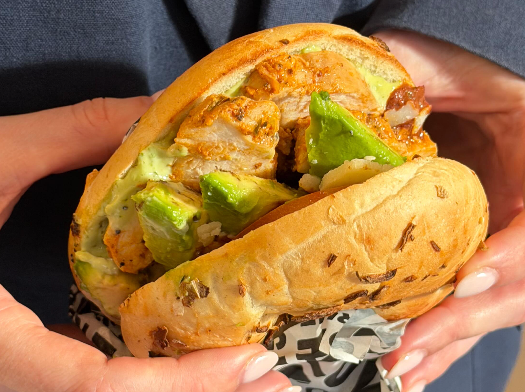
Similar to the Asian countries featured on our tour, the UK has reclaimed the bagel, rebranding it as an inherently British lunch staple. Having gradually moved away from the supermarket distribution of American commercial bagels, British bagel producers have shifted to a "bagel bar culture"; the bagel has taken on a "fast casual" identity in which bagels are ordered as part of a quick, sit-down meal, slightly fancier than the American deli. Importantly, the UK spells bagels as "beigels" because they believe that, due to London's geographical proximity to Eastern Europe, UK beigels are more authentic than their American counterparts (and thus, because "Beigel" is closer to the Eastern European pronunciation, the British refer to their bagels this way). Yet, despite claiming to access hundreds of years of bagel history, the UK beigal does not explicitly acknowledge the Jewish aspect of this heritage. Of the most popular beigel places in London on TripAdvisor, only one alludes to the bagel's Jewish heritage: it use the Yiddish word "mishpacha," meaning "family owned," on their site. The UK has compressed its national identity into its own, "traditional" bagel, yet has used geography to replace Judaism as the source of its claims to authenticity.
Montreal
Special Song:
(The Best?) Style

The last stop on our global tour is the one closest to home and best known for its distinct national bagel style: Montreal. Unlike the other stops on our global tour, the bagel did not arrive in Montreal as an American import, but rather emerged naturally from Montreal's isolated Jewish population. Montreal positions its bagels as closer to the original Jewish Eastern European bagel due to their bagels’ smaller sizes, denser textures, and larger holes. However, Montreal's claims to a more traditional bagel are not a product of the city accepting a Jewish ethnic food, but instead of the city separating the bagel from its Jewish ethnic origins. Throughout much of the 20th century, while bagel shops were allowed in the city's commercial centers, Jewish families lived in isolated enclaves. Consequently, the Montreal bagel has become a part of Montreal's heritage, not Montreal's Jewish heritage. Not only have both Montreal and the US seen the erasure of Judaism from the bagel's history, but they have also both contributed to further disregarding the bagel's ethnic identity. Heated debates over which style of bagel, Montreal or New York, is more traditional and enjoyable have increasingly relied on "scientific judgments" and "empirical comparisons," where bloggers use year-long taste tests to decide which region is "best." Even debates over the bagel's cultural impact have been regionalized, with Jewish bakers becoming pawns in US vs Montreal bagel arguments; in Twitter's National Bagel Day debate over the best bagel, there was only one mention of a Jewish person, Leonard Cohen, who was positioned as a "Montreal icon." Even though debates originally stemmed from competing claims to authenticity, the question of which bagel style reigns supreme has shifted from a debate over Jewish vs. non-Jewish to Montreal vs. New York.