ACT I
The Era of Culture & Containment (1890-1950)
Scroll to see some Act I sneak peeks!

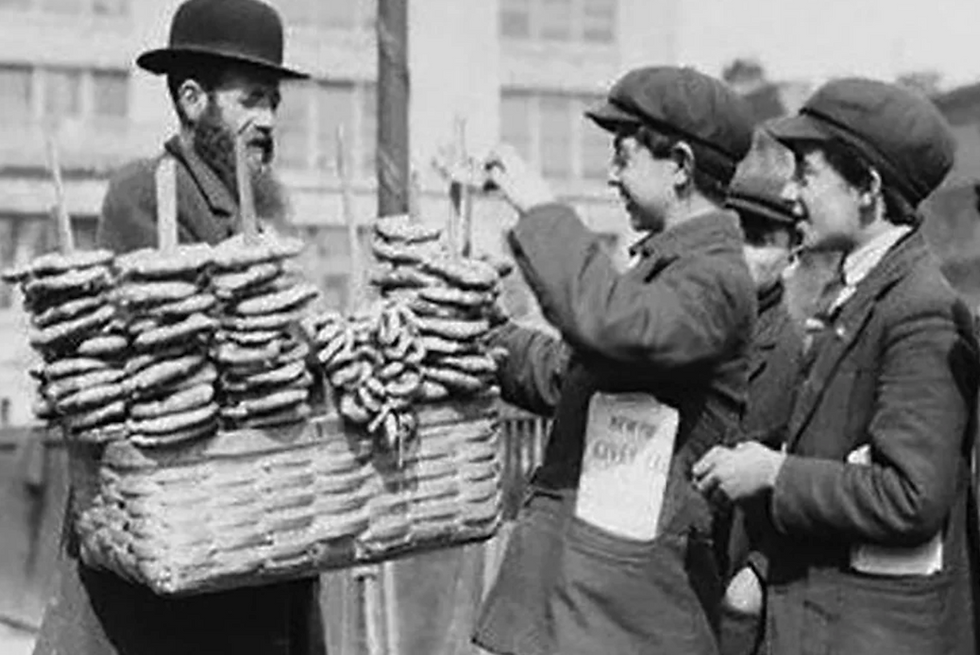

Set Design
For Act I, our set design is inspired by the bagel pushcarts and shops of the pre-WWII Lower East Side, affectionately known as the "unofficial capital of American Jewry." Before 1880, Jewish immigrants from Eastern Europe, fleeing religious persecution or seeking economic opportunity, had congregated in Jewish enclaves, where early bagel production was also geographically confined. Many (predominantly Ashkenazi) Jewish bagel producers in the late 19th century lacked the income to support brick-and-mortar shops, so the bagel's "set" was mobile: bakers used pushcarts as a low-cost way to sell their bagels. As Jewish communities grew larger and bagel production scaled between 1880-1920, bagel production moved into damp, vermin-infested basements of cheap tenement buildings. Conditions in these cellars grew so dire that NY factory inspectors, in a 1895 report, claimed that no other industry (even clothing sweatshops) had working conditions so "full of dirt and filth." They were not exaggerating: bagel bakers worked in nearly unbearable conditions, with temperatures averaging 110 degrees Fahrenheit year-round. Often, the only accommodations were wooden workroom benches to sleep on. Although working roughly 20 hours per day, bakers earned only $9-$18 a week, with much of that amount deducted for lodging. As the economic conditions of Jews improved over time, the brick-and-mortar deli was born. Operating as intercultural contact zones for Jews and gentiles in the 1930s and beyond, these shops prominently featured open kitchens, cases filled with Jewish food staples (such as whitefish salad, pickled herring, and Gefilte fish), and interior decor featuring Hebrew letters and murals of Eastern European villages. These delis became pedagogical third places for Jewish consumers, outside of home and work, which shielded Jewish identity from gentile America's scrutiny and allowed Jews to take on the role of cultural educators for bagel-curious gentiles.

Early Lower East Side Jewish bakery, est. 1920
Setlist
Our Hole

This track celebrates the most recognizable and subject-to-change aspect of the bagel's appearance: the hole. The ethnic bagel (a fist-sized, hard, and dark bread) featured a massive 4.5-inch hole reminiscent of bagels found in Eastern Europe. This hole was by no means a design choice; instead, the bagel's hole was a product of transporting the bread on rods and strings. Over time, however, the hole became a cherished symbol of Jewish identity. The large hole separated the Jewish bagel from other American breads, reinforcing gentile America's reluctance to try the food, while simultaneously connecting the Jewish community. To bite into a bagel did not merely mean eating bread; it meant honoring one's Jewish culture.
Speak Yiddish

"Speak Yiddish" recalls the linguistic gatekeeping practices of the International Beigel Bakers Union, also known as Local 338. Founded in 1907, Local 338 represented all Jewish bagel producers and reinforced the distinction between Jewish-American food consumption and American food consumption. To maintain a Jewish monopoly on the knowledge of ethnic bagel production, Local 338 strictly limited membership to the sons and nephews of existing bagel producers and, critically, held its meetings entirely in Yiddish. Consequently, Local 338 protected two key aspects of Eastern European Jewish identity: the ethnic language and the ethnic cuisine. Local 338 was a powerful force controlling bagel production, with leaders drawing on their families’s Eastern European progressive education and socialist leanings (ideals promulgated by Soviet influence in the region) to successfully win the right to represent all 30 NYC bagel bakeries by the 1930s. Thus, bagel production was a craft reserved exclusively for Jews.
Look What You Made Me Chew

Lindbergh rally

"Look What You Made Me Chew" explores the external exclusion that, coupled with Jewish bagel protectionism, made the ethnic bagel's acceptance in gentile America an impossibility before WWII. Pre-WWII, American antisemitism was rampant and pervasive. Political rhetoric weaponized negative Jewish stereotypes circulating during the time; in the late 1930s and early 40s, even as the Nazi campaign for Jewish eradication became glaringly obvious, powerful political figures such as Charles Lindbergh and Senator Burton K. Wheeler framed Jews as a "dangerous fifth column" pushing America into the war due to their "large ownership and influence in our motion pictures, our press, our radio and our government." Additionally, institutions, including elite universities and medical schools, enforced strict Jewish quotas, restricting Jewish access to American education and life. Antisemitic policies and rhetoric were not lost on the everyday American: a 1938-1940 poll reveals that up to ⅓ of Americans believe that Jews had "objectionable traits." The bagel, a symbol of American Jewish identity, was therefore just as objectionable, and its consumption limited to the Jewish community.
Senator Wheeler speaking at a rally
The Story of Dough
Act I's final track, "The Story of Dough", celebrates the bagel itself and the level of care and love required to produce it. Bagel production in the early 20th century required a highly skilled four-person crew that simultaneously operated coal- and wood-fired ovens, hand-shaped dough, and managed the boiling stage. Boiling the dough was a production technique unique to the bagel and remains a cherished aspect of bagel production today. Additionally, the ethnic bagel's dough underwent a 12-hour-long fermentation process to develop its distinct, nutty, deep flavor. The dough of the ethnic era was unique and fleeting, disappearing alongside many of the complex production techniques that shaped it, as bagel production technology radically reshaped production processes. Yet, for the era of the ethnic bagel, the traditional and gatekept methods that shaped the bagel's dough rendered the bagel a powerful symbol of Jewish identity.


Meet the Band

the ovenman
The ovenman, also known as the foreman, served as the bagel production quartet's (one ovenamn, two rollers, and a kettleman) leader and managed the complex, high-stakes production process. Specifically, the ovenman operated the coal- and wood-fired ovens, meaning he endured temperatures exceeding 110 degrees Fahrenheit. For ovenmen, heat stroke was simply part of the production process. Additionally, as the leader of the four-person bagel production crew, the ovenman exemplified the structural power of Local 338. Always a member of the union, the ovenman ensured that knowledge of bagel production remained accessible only to Jews, cementing the ethnic bagel's identity as a Jewish food.

the rollers
The rollers, who were often referred to by their Yiddish name, benehmen, were responsible for transforming the ethnic bagel from an extremely stiff, high-gluten dough into its iconic form. Since traditional bagel dough recipes incorporated as little water as possible to retain the bagel's dense texture, the rollers needed to exert massive upper-body effort to hand-shape each lump of dough into the bagel's notorious, perfect, pretzel-like ring. Most importantly, the rollers created the bagel's 4.5-inch hole, which allowed for bagel transportation and distinguished it from other gentile breads. Without the rollers’ craft and care, the ethnic bagel would have ceased to exist.

the kettleman
The kettleman completed the production of the ethnic bagel. He mastered the boil-then-bake craft, using traditional Eastern European techniques rather than Western bread techniques. He boiled the bagels for a full two minutes, resulting in the ethnic bagel's thick, charred crust and hard, dense texture. The specific bagel technique was a protected secret of Local 338 and, most visibly and texturally, separated the bagel from its white, gentile American bread counterparts (such as rolls and white bread). Thus, the kettleman played a pivotal role in defining the ethnic bagel as a Jewish food rooted in Eastern European tradition rather than as white bread that appealed to the broader American public.